RICHMOND, Va. – New statewide polling finds that Virginia voters see a strong K-12 public education system as critical to the Commonwealth’s economy and future workforce, while broadly supporting greater investment to address challenges facing Virginia’s schools and ensure students are prepared for a rapidly changing economy.
Commissioned by the and conducted by a bipartisan team of national public opinion firms, the polling found that voters have confidence in Virginia’s public schools but also see a clear need for continued improvement. A large majority of poll respondents believe Virginia’s K-12 schools are a sound place to invest public dollars but also recognize the need for increased investment in our public schools, a new approach to how Virginia funds its schools, and other necessary actions across a range of K-12 priorities.
Among the findings:
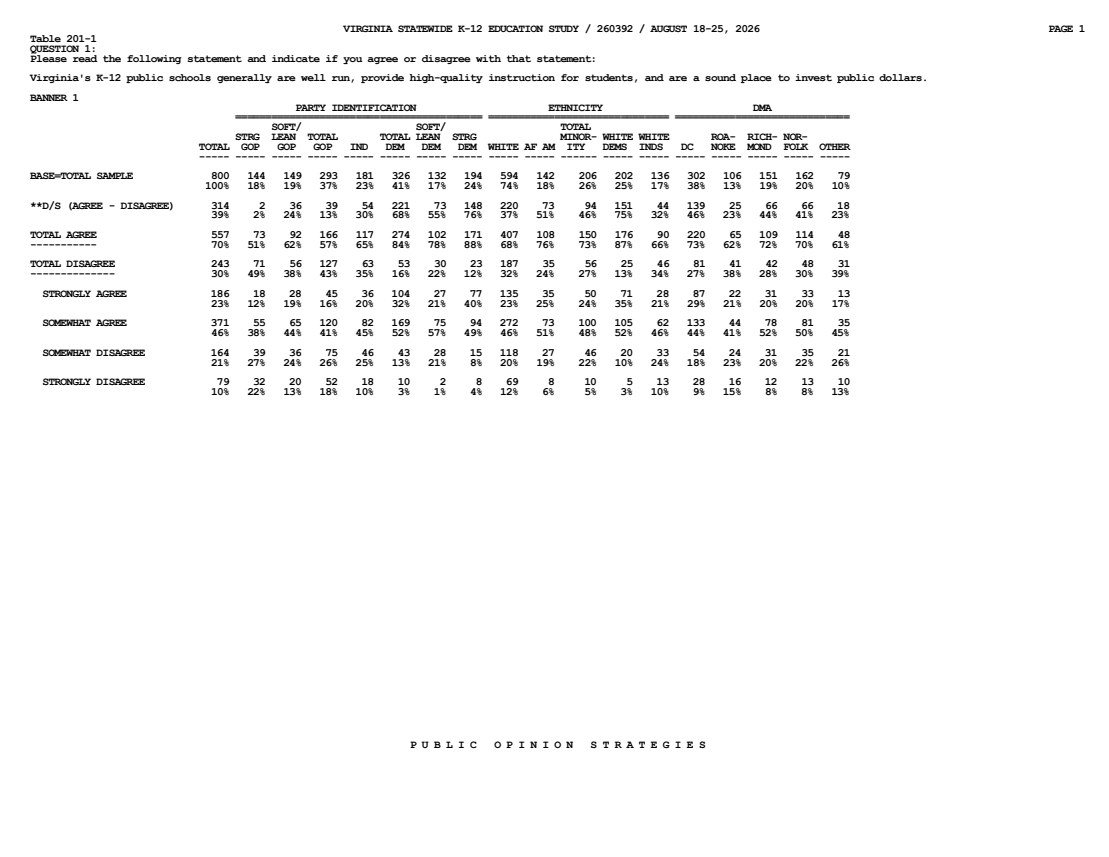
- Virginians value their public schools: 70% agree Virginia’s K-12 public schools are generally well run, provide high-quality instruction, and are a sound place to invest public dollars; 74% say Virginians should be proud of our K-12 public education system
- K-12 education is an economic driver: 94% say Virginia's K-12 public schools are important to improving the state and local economy; 88% say they are important to attracting new business investment and creating more job opportunities in Virginia
- Voters support greater investment: 91% say it is important to invest more in K-12 education given that the Commonwealth of Virginia spends approximately $2,000 less per student than the national average; 97% say K-12 investment is important to maintaining Virginia’s standing as a top state for business and attracting new investment and creating jobs
- Voters support changing how Virginia funds its schools: 87% support a new funding model that invests at or above the national average per student
- Instructional Excellence: 97% say addressing Virginia’s teacher shortage is an important reason to invest more in K-12 education; 92% support a comprehensive approach to recruit and retain teachers; 84% support developing a pipeline of highly qualified school principals
- Dual Enrollment: 87% support making it easier and more affordable for high school students to earn college credit through dual enrollment
- Career and Technical Education: 93% support a comprehensive strategy to expand CTE opportunities
- Career and College Pathways: 95% agree that every Virginia K-12 graduate should have access to education or training leading to an in-demand job; 90% support expanding high school internship opportunities
- Student Proficiency and Preparation: 95% say it is important to invest more in public schools to address student performance, pandemic-related achievement gaps, and workforce readiness
- Enhanced Learning Environments: 78% support allowing localities to adopt a 1% sales tax increase for school construction; 90% support expanding access to reliable high-speed broadband
The new polling will help inform the Partnership’s policy priorities and engagement with state leaders heading into the 2027 General Assembly session. The findings align closely with for strengthening Virginia’s K-12 public education system.
“Virginia’s economy is only as strong as the talent we develop, and that work begins long before someone enters college or the workforce,” said Stewart D. Roberson, president and chairman of the Virginia Business-K12 Partnership. “These poll results show that Virginians understand the connection between our economy and K-12 education. They value their public schools, recognize the challenges facing them, and support the investments needed to ensure students are prepared to succeed. This data gives business and education leaders a strong foundation to identify areas of common ground and develop practical solutions.”
“Virginia employers understand that our future workforce is sitting in classrooms today,” said Gina Patterson, executive director of the Virginia School Boards Association. “If we want Virginia to remain competitive, we have to make sure our schools have the resources they need while doing a better job of connecting what students learn with the skills, experiences, and opportunities they will need in the workplace. These polling results reflect that Virginians see that connection too.”
“Our schools are being asked to prepare students for a world that is changing faster than ever, while also confronting very real challenges in our classrooms and communities,” said Scott Brabrand, executive director of the Virginia Association of School Superintendents. “This data shows Virginians understand both the importance of investing in strong public schools and the need to continue improving how we prepare every student for what comes next, whether that is college, a career or another pathway.”
“Virginia cannot separate the future of K-12 education from the future of higher education or our workforce,” said Kirk Cox, president of the Virginia Business Higher Education Council. “Students need strong academic foundations and clear pathways that carry them from the classroom into college, credentials, and careers. Strengthening those connections will be critical to developing the talent Virginia, our businesses, and our institutions need to remain competitive.”
The full survey results, including topline results and crosstabs, as well as a summary of the findings, are available on this page.
###
About the Poll
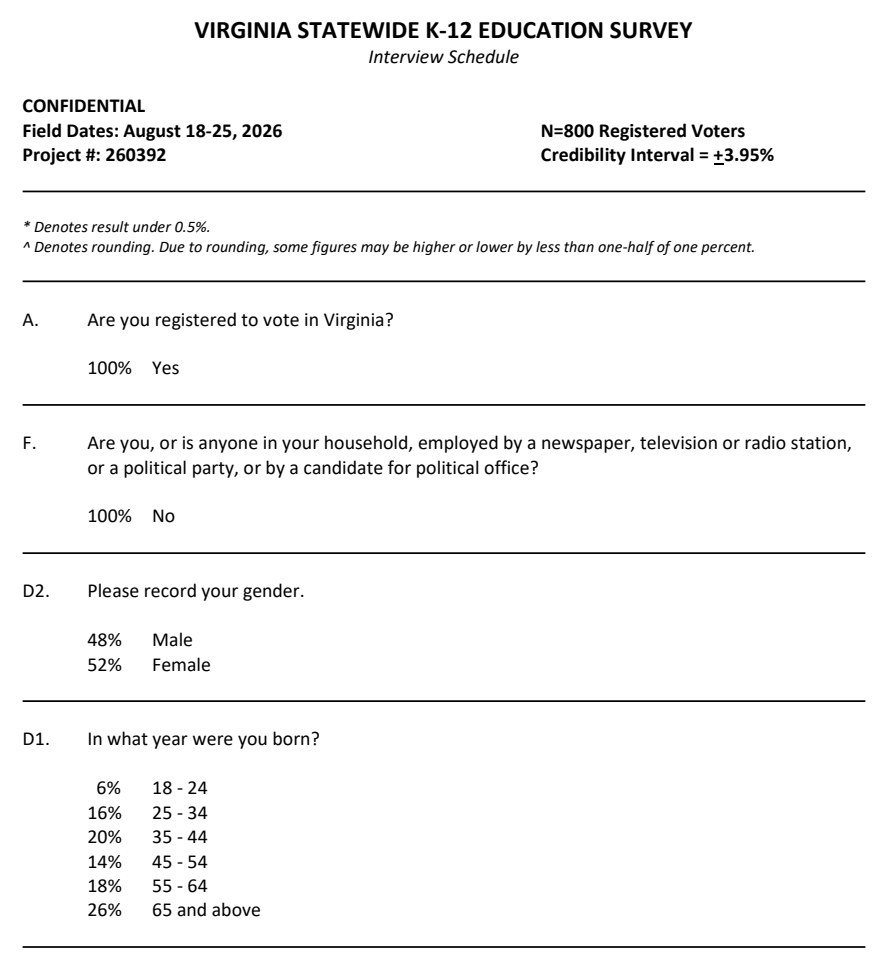
A bipartisan team of national public opinion firms conducted this statewide survey. Public Opinion Strategies, a Republican firm, and Frederick Polls, a Democratic firm, surveyed 800 registered Virginia voters from Aug. 18-25, 2026. Interviews were conducted online, and the survey has a credibility interval of ±3.95%.
About the Virginia Business-K12 Partnership
The Virginia Business-K12 Partnership brings together leaders from Virginia’s business and K-12 education communities to strengthen the connection between public education, talent development and economic growth. The Partnership works to develop consensus strategies to strengthen Virginia’s schools, prepare students for success, and ensure the Commonwealth has the talent needed to compete in a changing economy.
Learn more